Strange Breeds Of Cats- The Elf Cat

Are you ready to take home an Elf Cat? These unique cat breeds have some amazing temperaments that make them a great choice if you want a good indoor cat. So, what is there to know about the Elf Cat? Here is some information that should equip you accordingly.


• Attention Needing


The first thing you should know about the adorable Elf cats is that they are quite affectionate. Furthermore, these cats are friendly and they enjoy being loved. Don’t be surprised when you see the Elf cat sitting on your lap when you are on the sofa. She just wants to enjoy your love and the warmth of course.


• Grooming Needs


You will definitely want to keep your cat clean at all times. Well, the good thing is that these cats don’t have thick hair like other cats. For that, you won’t experience the constant shading. Even with their naked skin, these cats will want some regular cleaning.


They might have hairless skin, but the skin is wrinkled, and dirt can hide between the wrinkles. When you want to clean the cat, you’ll need some warm water, along with mild soap. Besides the skin, you should also check the ears, eyes, and nails for any debris buildup. For the eyes and ears, you should use damp cotton to clean the cat accordingly.


• Common Behaviors


You don’t have to worry about the behavior of the Elf cat. First off, they are quite well-mannered, especially when around other pets. You can also trust them around your kids because they are patient enough. This cat breed is one of the most social, and you will enjoy having him in the house. However, you will need to know that the Elf Cat don’t respond so well outdoors. That is why you need to keep him away from the direct sun.


You can enjoy traveling with this cat since they can be silent and they won’t disturb you as most cat breeds do.


• Health matters


While this cat breed might seem fragile to hang outdoors in the direct sunlight, they do have a strong immune system. The cats are resistant to a lot of diseases, making them a good choice if you want to save on the cost of treatment. If you take care of the Elf cat appropriately, you should expect them to last for almost 13 years.


With these temperaments, you should expect to get some relative Elf cat prices from the breeders. The good thing is that you will really enjoy having this cat breed at home. For more information on where you can find a reputable Elf Cat Breeder look no further than our good friend at Purrbastetsphynxandbambinos.com


10 incredible facts about insects!

10 incredible facts about insects!

1-How many insects are there in the world?

Scientific studies estimate that about 90% of living species are insects. This for several reasons:

  • Their remarkable abilities to reproduce.
  • Their small sizes, which allows them to hide easily from predators.
  • The exoskeletons that protect them optimally.
  • For some, their wings, which allows them to flee quickly and get safe.


 2-Do you know the beetles?

They come from the Coleoptera family and represent about 40% of the insect species. More than 380,000 species have been described to date.


3-How many ants are there in the world?

Do you like to observe ants in the summer? Know that for every human, there are 1.4 million ants.


4-Are there any insects in Antarctica?

While insects have been found almost everywhere on Earth, there are only one species of insect living in Antarctica. It is a gnat, the Belgica Antarctica. It measures between 0.2 and 0.58 cm, however, it is the largest terrestrial species present in Antarctica. It resists the freezing of body fluids because it absorbs sunlight to warm up.


5-Are there insects in the oceans?

The oceans are the only places where there is no presence of insects. It is assumed that the absence of plants for their diet and their habitat explains this absence. Another hypothesis suggests that the oceans are the guarded place of their cousins ​​the crustaceans.


6-How do the insects breathe?

Unlike humans, insects do not breathe through the mouth. Holes in their exoskeletons allow them to inhale oxygen and exhale carbon dioxide.


7-Do insects have blood?

Insects have no blood but hemolymph. The organs are bathed in this hemolymph. Their hearts along the back of the animal contracts to send the hemolymph to the head. The hemolymph is light in color but can also be yellowish or greenish.


8-When do the first insects date?

The oldest insect fossil is about 400 million years old. It is assumed that they are part of the very first animals and that they were present about 170 million years before the arrival of the dinosaurs.


9-What is the biggest insect?

The known insect is an ancient species of dragonflies called Meganeuropsis, or griffin fly of a size up to 0.8 meters in scale. She was a Hunter of insects and small amphibians. She lived about 250 to 290 million years ago.


10- What is the longest insect?

The longest known insect is a species native to the island of Borneo, it is Phobaeticus. It can measure up to 66 cm

  • What is the heaviest insect?

The heaviest insect known is a grasshopper species native to New Zealand. It’s the giant Weta. It can weigh up to 500 grams.

  • What is the smallest insect?

The smallest known insect is Costa Rica’s Mymaridae. It is a species of wasp whose male is barely 0.139 mm.

What you need to know about the insect stick leaf

Life of the insect stick leaf

You can place your leaf stick insect in a glass terrarium or in a wire terrarium.

The advantage of the terrarium wire is that it will be much better ventilated. Indeed, keeping the terrarium is very important for maintaining a sticky leaf. 

A glass terrarium can cause the death of some leaf stick insects, especially when they are small. Spraying the glass walls creates a suction cup effect, and the small leaf stick insect can easily be stuck on the walls.

Feeding the leaf stick insect

Many leaf stick insects, at any stage, die due to lack of food. It is, therefore, necessary to correctly position the branches that will be used to feed them.

A branch to a little too far from the insect stick is an obstacle to regular feeding, and they could die from it.

It is essential that leaf stick insects have easy access to their food.

This is why it is better to get the leaf stick insects, especially babies, in a terrarium that is too large.

A large number of leaf stick insects. So be sure to find out what is best for your species.

Make sure to get your leaf sticks insects with sheets of appropriate size. Leaves that are too large, for example, causes difficulties for small leaf stick insects.

It is not advisable to choose a baby’s nest egg or bramble for feeding baby leaf stick insects. They are softer and will be easier to eat.

You can also cut the edges of some leaves to make the “juices” come out and make them more appetizing for leaf stick insects.

However, only a few leaves as they turn black very quickly. You will be in the blackened area every 2 days.

Be careful where you pick up your leaves. And above all, try to avoid leaves with pesticides. Leaf sticks would not survive. The ideal is to provide a forest.

The substrate of the insect stick

Coconut fiber can be used to maintain moisture even in a wire terrarium.

But many people prefer to wipe it all off and just have to moisten it.

Be aware that egg-laying can be done without any problem in the coconut fiber. Feel free to put up to 5 cm thick.

You can add on the coconut fiber to the brambles. To prevent the phasms from drowning, you can cover the jar with a small piece of aluminum.

For their success and survival, maintaining good moisture is essential for insect leaves. Indeed, they can not succeed if their skin is too dry.

So spray the brambles and substrate and place your insect in the terrarium in complete serenity. Visit Linsecterie.com to discover the variety of leaf insect for sale.

Breeding For Beginners

A tropical stick insect in Brazilian garden

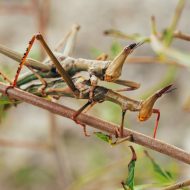
Stick Insects are found in the and around sticks,  twigs or barks. Home legume breeding is allowed for most species. However, it is essential to know how to maintain them at best.

Unlike other farms, the breeding of stick insects does not require to have a large budget.

The feeding of stick insects

Most of the feeding of stick insects are easily found in nature. Some will eat ivy, Mille-pertuis, others of laurel and others of privet … The tastes differ according to the species.

The bramble, this unwanted weed of our gardens and which stings, remains their favorite food.

Be sure to rinse the leaves and branches that will serve as a meal for stick insects. This will help on the one hand to evacuate all the polluting gases found in nature and on the other hand to eliminate some insecticides present which could kill the stick insect.

Also, it moistens the leaves. Stick Insects can hydrate by drinking these droplets of water.


The reproduction of the stick insects

Many stick insects reproduce by parthenogenesis. That is, there is no need for mating between the male and the female for reproduction. In the wild, the sticks move very little and have few opportunities to meet.

Parthenogenesis then allows female phasms that do not encounter males to reproduce and maintain their species alive.

In terms of species of stick insects, some eggs will be dropped on the ground, while others will be buried.

The eggs of stick insects differ according to the species, and most of the time resemble seeds of different shapes.

Once the eggs are harvested, they must be incubated at a temperature and humidity appropriate to the species.

You will first get really small sticky pups (stage L1). Stick Insects then use molting to grow.

When they grow up and the skin becomes too narrow, they get rid of it for a bigger one.

A baby is of stage L1 and an adult can go to the stage L6, L7. That is to say, he will have molted 5, 6 or even 7 times.

In some, incubation can be up to 10 to 11 months.


Terrarium landscaping for stick insects

You can cover the bottom of the terrarium with paper towels, substrate, or untreated potting soil.

The advantage of the paper towel is that it is easier to maintain. Just remove it and replace it when it is dirty.

The earth when it holds moisture well. Vermiculite can also be used for egg incubation.

Place on vermiculite, potting soil or paper towel with a small pot containing water with the lid pierced to insert brambles.

For sticky babies, it is advisable to generously fill the terrarium with brambles to facilitate their feeding.

Also, be sure to moisten the terrarium by spraying the soil and leaves. A hygrometry of 60% to 80% must be obtained according to the species.

Then place your sticks on the leaves. All you have to do is observe them.